AI Change Management

From AI tool burnout
to teams that enjoy AI.

The AI transition team helps companies integrate AI — and keep people productive while tools, models, and versions keep changing.

We maintain your knowledge. We also maintain your AI knowledge.
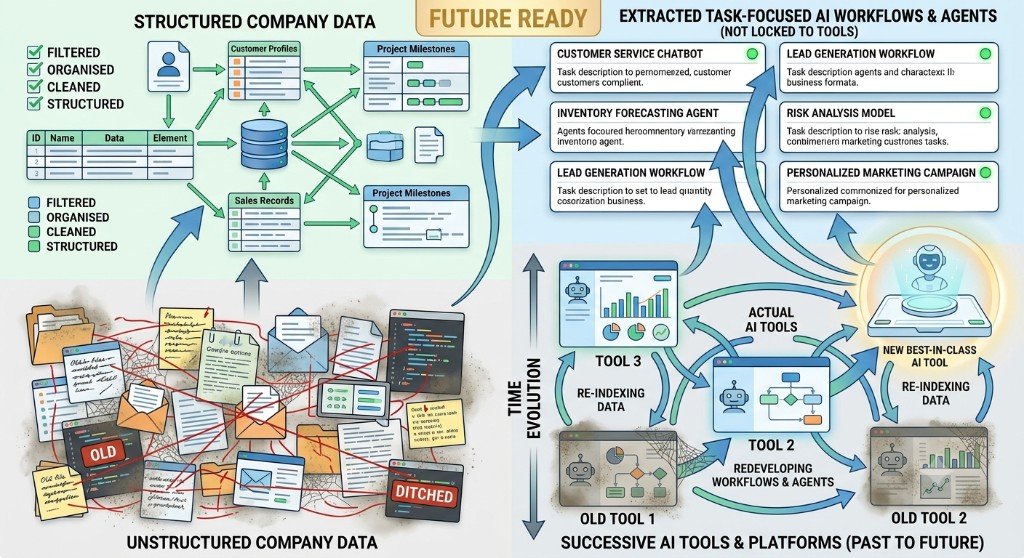
Future ready: unstructured company data becomes structured knowledge and task-focused AI workflows that plug into successive AI tools over time
Future ready — structured company knowledge and AI workflows stay portable as tools change.
The problem

AI Never Stands Still

Tools and models change constantly. Users get lost learning each new one — a few keep up, many disconnect, some never learn.

Default vs KM4AI

Stop Throwing Tools Over the Wall

Most company IT–AI teams drop the new product on users and call it done. Our model transitions data and experience — so stress drops and work keeps flowing.

Throw the tool to users

  • Cold cutover to the latest stack.
  • Hope people “figure it out.”
  • Agents and automations break or go stale.
  • Knowledge of how work was done evaporates.
  • Burnout: permanent retraining mode.

Adaptation before adoption

  • AI transition team leads — tools enter adaptation first.
  • Comparison matrix and use-case knowledge base before rollout.
  • Corporate knowledge and AI knowledge preserved.
  • Star users help lightly (busy by nature) — typically ≥1 per team.
  • Users keep working — and start enjoying AI.
Objectives

What We Protect

KM4AI is grounded in KM, KCS, and OKF — and includes change management plus integration with new tools.

Your knowledge

The curated, governed corporate knowledge base — sources, taxonomy, permissions, and reusable know-how that any AI can rely on.

Your AI knowledge

Agents, prompts, automations, workflows, and the operating patterns of how your organization actually uses AI — migrated when tools change.

Methodology

AI Transition Team Leads

New tools enter an adaptation/transition phase before they reach users. The AI transition team carries the work. Star users help lightly — typically at least one per team, usually busy for being stars.

01

Intake

Pull the new tool into adaptation first — not a broadcast rollout.

Star users do: join as named team contacts (≥1 per team).

02

Compare & map use cases

Build a comparison matrix and an AI Use Cases Knowledge Base — characteristics, successful/unsuccessful cases, training curve.

Star users do: validate adapt / drop / add for their team’s real work.

03

Transition preparation

Migration scripts, training, demos, live sessions, and consulting channels — so people move with support, not a cold cutover.

04

Ramp-up

Coach users on new capacities to raise efficiency beyond basic adoption.

Star users do: point experts at high-value team opportunities.

05

Preserve knowledge

Validate the same knowledge is reachable; adjust formats if needed; build AI knowledge — use cases, agents, workflows.

Star users do: contribute team-specific use-case and agent needs.

06

Continuity

Maintain company and AI knowledge. Improve adoption and performance as tools keep changing.

Star users do: periodic light review of team use cases.

Outcome

Less stress. Steady work. AI people can enjoy.

Teams keep delivering while the stack evolves — with knowledge and AI knowledge still under control.

Next step

Ready to integrate AI
without burning out your teams?

Talk through how adaptation-before-adoption fits your stack and your people.